Why this matters
Standard supplier-buyer transactions are simple: agreed price, agreed delivery, money changes hands, goods arrive. White-label (OEM/ODM) production adds layers that go wrong in ways standard transactions don't:
- Your branding sits on a third party's chassis — what happens if the supplier sells the same hardware to your competitor with their branding?
- The certifications on the product are the factory's; what happens if you need them transferred to your brand for a specific market?
- If a customer has a warranty claim on a product carrying your brand, who actually handles it — and how do you keep your end customer happy if there's a delay?
These questions matter. The six below cover the failure modes I've seen repeatedly across the OPS PC industry.
Question 1: When is the NDA signed?
Before any specifications, branding artwork, or volume commitments are exchanged.
Many suppliers will happily collect your branding files, target volumes, and pricing intentions before any NDA is in place. Once you've shared all that, you've lost leverage and (more importantly) you've shared commercially sensitive information without protection.
The supplier signs a mutual NDA before any specification exchange. The NDA should explicitly cover: your branding assets, your SKU naming, your target markets, your pricing intent, your customer information, and any custom technical specifications you've requested.
Walk away from any supplier who pushes back on signing an NDA upfront. They're either inexperienced or have already shared their other customers' specs with you (which means they'll share yours with someone else).
Question 2: What IP isolation do you offer?
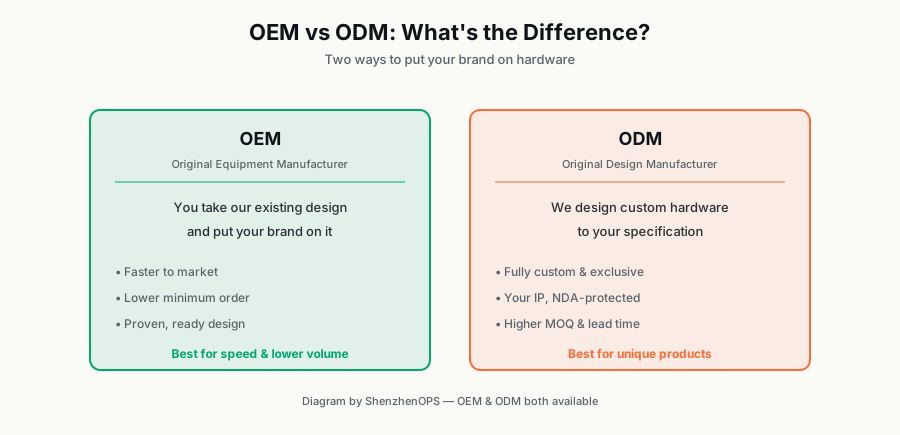
"Isolation" means: how do you ensure my branded products, my custom design elements, and my market positioning don't bleed over to other customers using the same supplier?
Three levels of isolation in practice:
Cosmetic isolation (Tier 1)
Same underlying hardware, different logo. Acceptable for distributors who are functionally re-labeling without competing on engineering. Common, low-cost, and adequate for most small-volume white-label arrangements.
Engineering isolation (Tier 2)
Same base hardware, but custom chassis design, custom packaging, and (potentially) custom firmware branding. The end customer can't easily reverse-engineer that this is the same as Brand X's product. Requires moderate volume (50–200 units typically) and additional engineering setup time.
Hardware isolation (Tier 3)
Custom motherboard, custom I/O configuration, custom thermal/chassis design, exclusive supply guarantees. Requires significant volume (500+ units) and 6+ month relationships. Most expensive but offers the strongest moat against competitor copy.
For each tier, ask the supplier in writing: (a) what's included in this tier, (b) what's not included, (c) what's the exclusivity guarantee.
Question 3: How does certification transfer work?
Most factories hold certifications (CE, FCC, RoHS, EAC) under their own brand name. When your product ships with your brand on the chassis, what's actually printed on the cert?
Option A: Ship under factory cert with your re-label
Common, simple, but means the EAC certificate names the factory, not your brand. Acceptable for most countries; some Russian customs officers occasionally question this. If your customers ask "show me the certificate", you'd need to provide a factory-named certificate (which may reveal supplier relationships you'd rather not share).
Option B: New certification under your brand
The factory submits documentation under your brand name to obtain a fresh certificate naming your brand. Takes 4–8 weeks (depending on certification body), costs $1,500–$6,000 depending on certification, and is only economical for higher-volume relationships.
Option C: Your existing certifications
If you already hold CE/FCC/EAC for similar products under your brand, the supplier can manufacture against your existing cert. Requires careful coordination on product specifications and traceability.
Decide which option fits your project upfront, and confirm the supplier will support it.
Question 4: What exclusivity do I get?
"Exclusivity" can mean very different things. Be specific:
Brand exclusivity
The supplier commits to not selling product to others under your brand name. Standard practice; should be in any white-label contract.
Geographic exclusivity
The supplier commits to not selling to others in your geographic territory. Common for distributors who've invested in market development. Typically requires volume commitments (e.g., 1,000+ units/year minimum).
Hardware-design exclusivity
The supplier commits to not selling the same (Tier 3) custom-designed hardware to anyone else, regardless of branding. The strongest protection; requires the largest volume commitment.
Customer-segment exclusivity
The supplier commits to not selling to your specific named customers or vertical (e.g., "you have the education vertical in Russia"). Hard to enforce in practice; rarely worth the contract effort unless you have a meaningfully unique relationship.
For each form of exclusivity you want, ask: (a) what's the term (1 year? 3 years?), (b) what's the volume threshold to maintain it, (c) what's the penalty if violated.
Question 5: What are the actual payment terms?
"30% deposit, 70% before shipment" is the headline. The details matter:
- When does the deposit clock start? Standard: production timeline begins when deposit clears, not when you wire it.
- What does "before shipment" mean exactly? Before goods leave factory? Before B/L is issued? Before container is loaded? Each is a different point in time, with different risk for buyer and seller.
- What's the QC photo deadline? Some suppliers send photos 24 hours before they need balance payment, leaving you no time to react. Standard practice should be 48–72 hours.
- What's the dispute mechanism if QC photos reveal defects? Production line corrections vs. partial-batch rejection vs. full refund — confirm upfront.
- What's the payment method requirement? Bank transfer only? LC? Cryptocurrency? Each has different settlement timelines.
Question 6: Who handles aftersales — and how, exactly?
Your end customer has a defective unit. What happens?
The end customer's experience matters
Your end customer doesn't know or care that you sourced from a Chinese white-label supplier. They contact you for warranty support. If your supplier's warranty process is slow, your customer's slow experience reflects on your brand.
Practical RMA flow for white-label OPS
- End customer reports defect to you (the distributor)
- You issue an RMA reference and instruct customer to ship the unit back to you (not to China directly — never give end customers your supplier's address)
- You consolidate RMA units monthly or quarterly and ship to your supplier as a batch
- Supplier repairs/replaces at their cost; sends replacements back to you
- You re-ship to end customers
Confirm with supplier upfront
- RMA turnaround time (target: 14–21 days from receipt in Shenzhen to dispatch)
- Who pays inbound vs. outbound freight (standard: you pay inbound, supplier pays outbound)
- Whether spare boards are stocked at distributor location for fast in-territory replacement
- What happens after warranty expires (cost of out-of-warranty repair?)
If your supplier goes out of business 18 months into your warranty period, what happens to outstanding warranties? Confirm whether they maintain a third-party-held escrow of spare parts (rare but excellent), have alternate-supplier agreements (more common), or simply rely on you to maintain stock yourself (most common — plan accordingly).
The honest evaluation
Every supplier you talk to will pitch their OEM/ODM capabilities. The six questions above filter quickly. Suppliers who can answer them clearly, in writing, are worth deeper engagement. Suppliers who deflect, change subject, or "we'll figure that out later" — keep moving.
White-label production is a multi-year relationship, not a one-shot transaction. The supplier you pick will represent your brand for as long as you sell their product. Choose like you'd choose a co-founder, not like you'd choose a t-shirt printer.
Ready to discuss a white-label production run?
We've helped distributors from 50-unit Tier 1 light branding to 5,000-unit Tier 3 custom ODM projects. Get in touch — NDAs signed before any spec exchange.
See OEM/ODM tiers →