What makes a PC "industrial"
The term "industrial PC" is loose. A reasonable definition: a PC built for environments and lifecycles that consumer hardware cannot survive. In practice, an industrial PC differs from a regular mini PC in six ways:
- Chassis material. Aluminum alloy or steel, not plastic. Aluminum chassis acts as a passive heatsink for the CPU; steel adds physical durability.
- Thermal design. Often fanless (passive cooling). Where fans are present, they're industrial-grade with sealed bearings and dust filters.
- Operating temperature. Standard IPC spec: 0°C to +60°C. Wide-temp variants: -20°C to +70°C. Consumer mini PCs typically rated 0°C to +35°C.
- Mounting options. DIN-rail, panel-mount, VESA, wall-mount kits standard. Consumer mini PCs usually only support VESA or desktop placement.
- Industrial I/O. RS-232/RS-485 serial, GPIO with optical isolation, CAN bus, sometimes 4-20mA analog inputs. Most consumer mini PCs have only USB and Ethernet.
- Product lifecycle. Industrial vendors guarantee 5-7+ year availability of the same SKU. Consumer mini PCs typically last 18-24 months before EOL.
When you actually need industrial spec
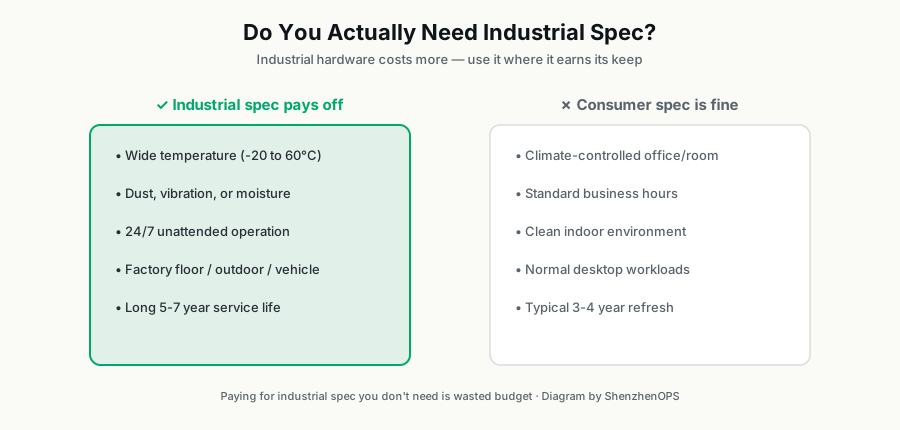
Pay for industrial spec when at least one of these is true:
- Ambient temperature exceeds 40°C or drops below 0°C. Factory floors, outdoor cabinets, vehicle-mount applications, food storage facilities.
- Vibration is constant. Mounted on machinery, in vehicles, near heavy equipment. Hard drives are out; SSDs and ruggedized PCB mounting matter.
- Dust is unavoidable. Cement plants, woodworking shops, mining facilities. Fanless or filtered fan designs only.
- The deployment will run 7+ years. Industrial PC vendors won't EOL the SKU on you mid-lifecycle.
- Legacy industrial protocols required. RS-232/RS-485 for PLCs, CAN bus for vehicles, isolated GPIO for sensors. Hard to find on consumer hardware.
- Downtime cost is high. Manufacturing line where a PC failure stops production = pay for the more reliable hardware.
When you don't need industrial spec
If your deployment is in a temperature-controlled office, classroom, retail store, or hotel room, paying for industrial spec is wasted money. A standard mini PC with a 2-year warranty handles those environments fine for substantially less.
CPU selection for industrial deployments
Most industrial workloads don't need flagship Intel Core silicon. Here's what fits each tier:
Intel N100 (4 cores, 6W TDP)
The 2024+ default for entry industrial PCs. Handles edge gateways, MES terminals, building automation hubs, KIOSK applications, basic SCADA HMI workloads. Fits in fully passive aluminum cooling with no fan. Power draw enables 24/7 operation at minimal energy cost.
Intel i3/i5 Mobile (10-12th gen)
When you need real compute: machine vision (basic), local data analytics, multi-stream camera processing, industrial PC running Windows IoT Enterprise with several apps simultaneously. TDP around 15-35W; usually requires an active fan.
Intel i7 (12-14th gen) or Xeon
Edge AI inference, complex machine vision (multiple cameras + ML models), real-time process control with high computation. Rare in true industrial form factors due to thermal envelope; usually only available in larger rugged box PCs.
Aluminum chassis: it's not just for looks
An aluminum-alloy case is doing real thermal work on a fanless industrial PC. The CPU's heat spreader is thermally bonded (via heat pipes or thermal pad) to the chassis interior. The chassis itself becomes the radiator. Surface area, fin design, and external airflow around the chassis determine sustained thermal capacity.
Practical implications for buyers:
- Mounting orientation matters. Wall-mount with fins vertical maximizes natural convection cooling. Horizontal placement on a desk reduces cooling capacity by ~20-30%.
- Cabinet placement matters more. If you're putting the IPC inside a sealed electrical cabinet, factor in cabinet internal temperature — it can easily be +15°C above ambient.
- VESA mounting reduces cooling. When the chassis is pressed flat against a wall or display back, the back fins lose effectiveness.
For 24/7 deployments in cabinets, derate the IPC's quoted operating temperature by 10°C. If the spec says 0°C to +50°C ambient, plan for 0°C to +40°C cabinet-internal temperature.
Industrial I/O: what to actually specify
RS-232 (serial)
Common in legacy PLCs, machine controllers, lab equipment. Looks like a 9-pin D-sub or sometimes a 3-pin or 5-pin terminal block. If you're integrating with any equipment older than ~2015, assume RS-232 will be needed somewhere.
RS-485 (multi-drop serial)
Used for industrial protocols like Modbus RTU. Differential signaling supports multi-device buses over longer cable runs. Common in building automation, energy monitoring.
GPIO with optical isolation
Digital input/output channels for connecting industrial sensors and actuators. Optical isolation prevents ground-loop noise from frying the PC. Specify number of channels and required voltage range (typically 12V or 24V industrial).
CAN bus
Common in vehicle telematics, mobile machinery, some industrial automation. If you're integrating into truck/bus/forklift systems, CAN bus support is non-negotiable.
What you usually DON'T need
- Multiple high-speed USB-C ports (industrial peripherals rarely use USB-C)
- Thunderbolt
- SD card slots (Industrial deployments use internal storage; SD cards are unreliable for 24/7)
- Display ports beyond what you actually drive
Storage: pick the right SSD spec
Consumer SSDs are rated for ~3 years of intensive write workloads. Industrial PCs running 24/7 logging applications can hit that limit fast.
Specify industrial-grade M.2 SSDs for true industrial deployments. They differ from consumer SSDs in:
- Higher TBW (Total Bytes Written) endurance — typically 5-10x consumer
- Wider operating temperature
- SLC or MLC NAND (more reliable than TLC/QLC)
- Power-loss protection — capacitors keep the SSD alive long enough to flush writes during power failure
Cost premium is ~30-50% over consumer SSDs. For a deployment writing logs continuously, it pays for itself within 18 months.
Dual M.2 storage and RAID
The SZO-IPC-N100 has dual M.2 NVMe slots. Common configurations:
- Software RAID 1 (mirror). Two SSDs running as a mirror; one can fail without data loss. Standard for any deployment where data loss is unacceptable.
- Software RAID 0 (stripe). Two SSDs combined for ~2x capacity and slightly higher throughput. Only for cache/scratch workloads.
- Two separate drives. OS on one, application data on the other. Easier troubleshooting; replacing one drive doesn't require full reinstall.
Connectivity: WiFi + cellular + Ethernet?
For most industrial PCs, wired Ethernet is primary. WiFi is a backup or for occasional mobile deployments. Cellular (4G/5G) makes sense for:
- Remote site monitoring (oil & gas wellheads, agricultural equipment, transportation logistics)
- Backup connectivity for critical applications
- Fleet vehicle telematics
The SZO-IPC-N100 standard config has Gigabit Ethernet + WiFi 5. Cellular is a custom factory option for 50+ unit orders.
Operating system choices
Three main paths:
Windows 10/11 IoT Enterprise LTSC
Microsoft's industrial-grade Windows. Same OS as desktop Windows but with: 10-year support guarantees, no forced updates, no consumer apps, lockdown features (Shell Launcher, Assigned Access, Embedded Boot). The choice for most industrial deployments.
Linux (Ubuntu Server LTS or Debian)
Free, stable, long-term support. Used for IoT gateways, edge compute, custom industrial applications. Lower per-unit licensing cost matters at scale.
Real-time OS (rare)
For deterministic real-time control (e.g., motion control, hard-real-time process control). Most industrial PC deployments don't actually need this — they need fast, but not real-time. Specify carefully.
What ShenzhenOPS ships in this category
Our current industrial PC catalog has one standard SKU (SZO-IPC-N100) covering most light-industrial use cases. For deployments requiring i5/i7 industrial, extended temperature range (-20°C to +70°C), IP65 sealing, or specialized industrial I/O (CAN bus, isolated GPIO, multiple RS-485 lines), we build custom variants for orders of 200+ units. Lead time on first custom batch: 6-8 weeks; subsequent reorders run on standard 25-day timeline.
Specifying industrial PCs for a deployment?
Send us your environment specs (temperature range, vibration, IP rating, I/O needs, quantity) and we'll match you to the right SZO-IPC config or recommend a custom build path.
Send specs to Vincent →