The short version
OPS (Open Pluggable Specification, 2010) and SDM (Smart Display Module, ~2017) are both Intel-led standards for slot-in compute modules in interactive displays and digital signage. SDM is the newer, smaller form factor designed to fit the thinnest displays. Both standards remain in active production in 2026, and the choice between them is dictated mainly by which slot your display has.
OPS has a metal chassis (180×119×30mm); SDM is housing-less and smaller (SDM-S: 100×60×20mm, SDM-L: 175×100×20mm). They are not interchangeable.
Why SDM exists
By the mid-2010s, display manufacturers were pushing chassis depths below 30mm. The metal-housed OPS module's 30mm thickness became a hard constraint. Intel responded with SDM — same goal (standardize slot-in compute for displays), but with a stripped-down form factor:
- No chassis housing. The SDM module is just a PCB with an edge connector — the display itself provides thermal management and physical protection.
- Smaller footprint. SDM-S is roughly the size of two business cards; SDM-L is closer to OPS-C width but only 20mm thick.
- PCIe Express x8 edge connector. Higher bandwidth than OPS's JAE TX25, future-proofed for 8K signaling.
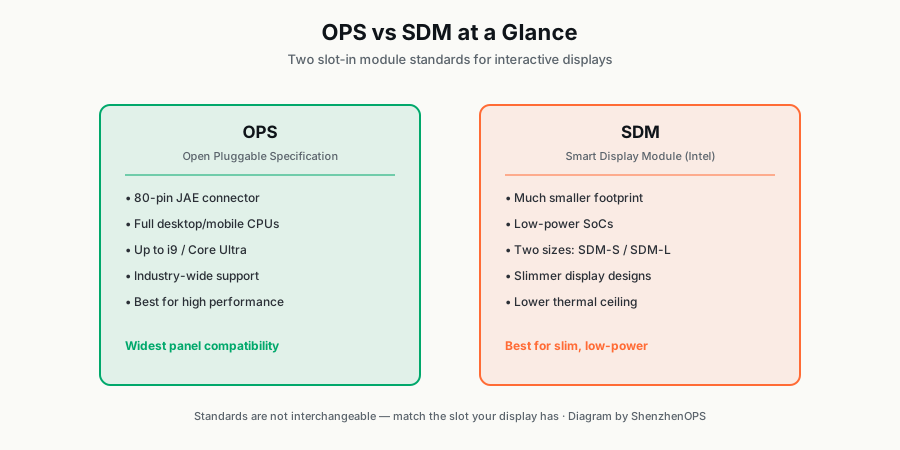
OPS vs SDM at a glance
| Standard OPS | OPS-C | Intel SDM-S | Intel SDM-L | |
|---|---|---|---|---|
| Introduced | 2010 | ~2020 | ~2017 | ~2017 |
| Dimensions | 180×119×30mm | 195×180×30 or 42mm | 100×60×20mm | 175×100×20mm |
| Housing | Metal chassis | Metal chassis | None (bare PCB) | None (bare PCB) |
| Connector | JAE TX25 (80-pin) | JAE TX25 (80-pin) | PCIe x8 golden finger | PCIe x8 golden finger |
| Typical TDP | Up to 65W | Up to 95W (42mm) | ~10W | Up to 45W |
| Display support | Up to 8K | Up to 8K | Up to 4K@60 | Up to 4K@60 |
| Future bandwidth | Limited by JAE | Limited by JAE | PCIe-future-proofed | PCIe-future-proofed |
Which CPUs run on each
OPS historically targeted mid-range Intel Core silicon: i3, i5, i7 from desktop and mobile lines. Today, OPS modules ship with everything from Intel N100 (~6W) up to i7-13650HX (~157W boost) and Intel Core Ultra with NPU.
SDM-S targets low-power compute: Intel Celeron, Atom-class, Pentium N-series. The thermal envelope (~10W TDP) effectively rules out i5/i7.
SDM-L sits in the middle: 9th–11th gen Intel Core (8th-gen Core was the original target), N-series Atom, and 12th-gen Core in newer modules. Approximate TDP ceiling: 45W.
Compatibility: the deal-breaker
This is where the rubber meets the road for buyers. An OPS module won't slot into an SDM-equipped display, and vice versa. The mechanical dimensions and electrical connectors are completely different.
What does your display use? Check the display's spec sheet for "OPS slot", "OPS-C slot", "SDM slot" — manufacturers usually call it out clearly. If unclear, contact the display manufacturer directly; they'll know.
The Sharp NEC migration
The most-publicized SDM transition is Sharp NEC's MESSAGE line of large-format displays. Sharp NEC has migrated this line from OPS to SDM-L, citing future-proofing for 8K resolution and slimmer chassis profiles. The migration started around 2023 and has progressed through subsequent product refreshes.
What this means for buyers: if you're standardizing on Sharp NEC MESSAGE displays for a multi-year deployment, you should plan around SDM rather than OPS. If you're working with displays from Samsung, LG, BenQ, Hikvision/Skyworth, or other major brands — most still use OPS as primary, with some newer models adding SDM as a parallel option.
Who manufactures each
OPS modules have a broad supplier ecosystem in 2026. Major vendors:
- NEC/Sharp (own-brand OPS for their displays)
- Axiomtek, Nexcom, Portwell, Advantech (Taiwan-based industrial PC vendors)
- Polywell, IAdea (US-based)
- Shenzhen-based manufacturers (the supply base ShenzhenOPS works with)
SDM modules have a narrower supplier list. The Intel SDM Partners Catalog lists Advantech, Axiomtek, Aopen, IBASE, and a handful of others. Shenzhen-based SDM production exists but is significantly less mature than OPS — partly because the market hasn't demanded volume yet.
When to choose what
Choose OPS when:
- Your displays use OPS or OPS-C slots (still the majority of installed base in 2026)
- You need higher-power CPUs (i7/i9, Intel Core Ultra) — SDM's thermal envelope is limited
- You're sourcing for 8K signage or video walls (i7-13G OPS works; SDM-L is bandwidth-constrained for full 8K)
- You want broad supplier choice and competitive pricing — OPS has more vendors
- EAC certification matters (Russia/CIS) — well-established OPS supply chain has EAC; SDM less so
Choose SDM when:
- Your specific displays (e.g., Sharp NEC MESSAGE) only accept SDM
- The chassis profile must stay under 22mm
- You're deploying basic signage (Atom/N-series compute is enough) and the smaller form factor saves shipping volume
- You're planning toward 8K via PCIe-bandwidth-dependent features
The pragmatic answer for most buyers in 2026
Unless you're specifically working with Sharp NEC MESSAGE displays or one of the other SDM-only product lines, OPS is still the default. The installed base of OPS-compatible displays remains massive, the supply chain is competitive, and the form factor still meets most current display thickness specs (especially OPS-C 30mm).
If you're buying displays and OPS modules together for a new deployment, ask the display vendor: "Does this model take OPS, OPS-C, SDM, or all three?" Many modern IFPs from major brands support OPS-C and/or SDM in parallel slots, giving you future flexibility.
What ShenzhenOPS ships today
Our standard catalog covers six OPS configurations across Standard OPS and OPS-C 30mm/42mm form factors, from Intel N100 entry to Intel Core Ultra AI flagships. We do not currently ship SDM-S or SDM-L modules in the standard SZO catalog.
If your project specifically requires SDM, we can either: (1) source it as a one-off through partner factories that produce SDM (longer lead times, smaller minimum orders), or (2) route you to a specialist SDM supplier — we'd rather you get the right product than the closest-fit one.
Sourcing OPS PC for displays sold today?
Both OPS and SDM remain in production. ShenzhenOPS ships OPS modules direct from Shenzhen. For SDM-specific projects we'll route you to the right specialist supplier.
Send project brief →